
A daily routine works when it's built around a few fixed points, not when it tries to script every minute. This free daily routine template gives you three anchors to plan around — a morning block to invest in yourself, a workday block to protect your focus, and an evening block to prep for tomorrow — plus a habit-stacking formula and three sample routines you can copy as-is. It's a practical daily routine planner you can print, paste into the app, or fill in by hand.
What a good daily routine template includes
The most reliable routines aren't the most detailed — they're the easiest to repeat. A useful daily schedule template gives you just enough structure to remove decisions, without locking you into a rigid minute-by-minute plan you'll abandon the first messy day. Look for these four elements:
- Three anchors, not a full timetable. A morning, workday and evening block hold the day together. Everything else flexes around them.
- A trigger for each new habit. A good morning routine template or evening routine template ties each habit to something you already do, so you don't rely on willpower.
- Time-boxed blocks. A time-blocked daily routine assigns rough start times so the plan confronts how much time you actually have.
- Room to make it yours. Sample routines get you started, but the template leaves blank lines so it becomes your daily routine, not a generic one.
The template: 3 anchors, habit stacking, and sample routines
Here's the full template. The table below shows the three anchors at a glance; underneath, the same template is available as plain text you can copy into the app, a note, or any document. Use the Print button for a clean one-page printout.
| Anchor | Goal | Example blocks |
|---|---|---|
| Morning | Invest in yourself | Hydrate · move · journal · set top 3 tasks · get ready |
| Workday | Protect focus | Deep work first · reset breaks · lunch away from desk · batch meetings · shutdown ritual |
| Evening | Prep tomorrow | Tidy · screens-off cutoff · lay out clothes · plan tomorrow · wind down |
DAILY ROUTINE — time-blocked, built on 3 anchors

MORNING (invest in yourself)  |  WORKDAY (protect focus)  |  EVENING (prep tomorrow)

--- HABIT STACKING FORMULA ---
After [existing habit], I will [new habit].
Examples:
  After I pour my coffee, I will journal for 1 minute.
  After I brush my teeth, I will drink a full glass of water.
  After I sit at my desk, I will write my top 3 tasks for the day.
  After I close my laptop, I will lay out tomorrow's to-do list.

--- SAMPLE ROUTINE A: 30-MINUTE MORNING ---
07:00 Wake, drink water, make bed
07:05 Get ready + affirmations
07:25 Grab prepped breakfast
07:30 Leave / start day

--- SAMPLE ROUTINE B: 60-MINUTE MORNING ---
08:00 Wake, hydrate, make bed
08:05 15-min movement + 5-min meditation
08:25 Coffee + breakfast, skim news
08:35 Get ready
09:00 Start work

--- SAMPLE ROUTINE C: 90-MINUTE MORNING ---
05:30 Wake, make bed
05:35 Brush teeth, drink water
05:40 Coffee + 10-min journaling
05:50 30-min walk or run
06:20 Breakfast + reading
06:35 Get ready
07:00 Leave for work

--- WORKDAY BLOCK ---
First 90 min: deep work on hardest task (phone in another room)
Mid-morning: 5-min reset break (stand, water, stretch)
Midday: lunch away from desk + short walk
Afternoon: meetings / shallow tasks batched together
Last 15 min: tidy desk, write tomorrow's top 3

--- EVENING WIND-DOWN ---
After dinner: tidy + dishes (stack: podcast/music)
~1 hr before bed: screens off, dim lights
Before bed: lay out clothes, plan tomorrow, 5-min journal/read

MY ROUTINE (fill in)
Morning: __:__ ______  __:__ ______  __:__ ______
Workday: __:__ ______  __:__ ______  __:__ ______
Evening: __:__ ______  __:__ ______  __:__ ______
A quick note. This is a general organization and productivity template, not medical, mental health, or fitness advice. The wellness items here — movement, meditation, a sleep cutoff — are common routine examples, not recommendations for your situation. For diagnosis or treatment of any condition, please consult a qualified professional.
How to build your daily routine in 4 steps
You don't need to fill in every line at once. Build the routine in the order that makes it stick:
- Set your three anchors. Pick a realistic start time for your morning, the moment your workday begins, and a wind-down time in the evening. These three points hold everything else together.
- Pick one keystone habit per phase. Choose a single new habit for the morning, one for the workday, and one for the evening — not ten. Stacking too many at once is the number-one reason routines collapse.
- Stack each habit on an existing one. Use the formula "After [existing habit], I will [new habit]" so every new habit has a concrete trigger instead of depending on memory.
- Turn it into reminders. Recreate each step as a recurring task with a reminder so the routine repeats on its own and nudges you at the right time.
Sample routines: 30, 60, and 90-minute mornings
Start from the sample that matches the time you actually have, not the time you wish you had. A reliable 30-minute morning beats an aspirational 90-minute one you skip. All three are in the copy-paste block above; here they are side by side:
| Time | A — 30 min | B — 60 min | C — 90 min |
|---|---|---|---|
| Wake | 07:00 — water, make bed | 08:00 — hydrate, make bed | 05:30 — make bed |
| Move / mind | — | 08:05 — 15-min move + 5-min meditate | 05:50 — 30-min walk or run |
| Reflect | 07:05 — affirmations | — | 05:40 — coffee + 10-min journal |
| Fuel | 07:25 — prepped breakfast | 08:25 — coffee + breakfast | 06:20 — breakfast + reading |
| Out the door | 07:30 | 09:00 — start work | 07:00 |
The workday block stays the same whichever morning you choose: the first 90 minutes go to deep work on your hardest task with the phone in another room, a short reset break mid-morning, lunch away from the desk, meetings and shallow tasks batched together in the afternoon, and a 15-minute shutdown ritual to tidy and write tomorrow's top three. In the evening, tidy after dinner, set a screens-off cutoff about an hour before bed, then lay out clothes and plan tomorrow.
How to use habit stacking so routines actually stick
Most routines fail not because the steps are wrong, but because there's nothing to trigger them. Habit stacking fixes that by attaching each new habit to one you already do reliably. The formula is simple: After [existing habit], I will [new habit]. The existing habit becomes the cue, so you don't have to remember or summon motivation.
- After I pour my coffee, I will journal for one minute.
- After I brush my teeth, I will drink a full glass of water.
- After I sit at my desk, I will write my top three tasks for the day.
- After I close my laptop, I will lay out tomorrow's to-do list.
A few rules keep stacking from backfiring. Add only one new habit per phase until it's automatic. Protect your first deep-work block by removing the trigger rather than resisting it — a phone in another room beats a phone face-down. And anchor your evening to that screens-off cutoff, paired with something you enjoy like music or a podcast, so the wind-down is a reward rather than a chore.
Turn your routine into automatic daily reminders
A printed template is a great start, but paper can't nudge you. The step that turns a routine into a habit is getting prompted at the right moment, every day, without thinking about it. That's exactly what a task app does well.
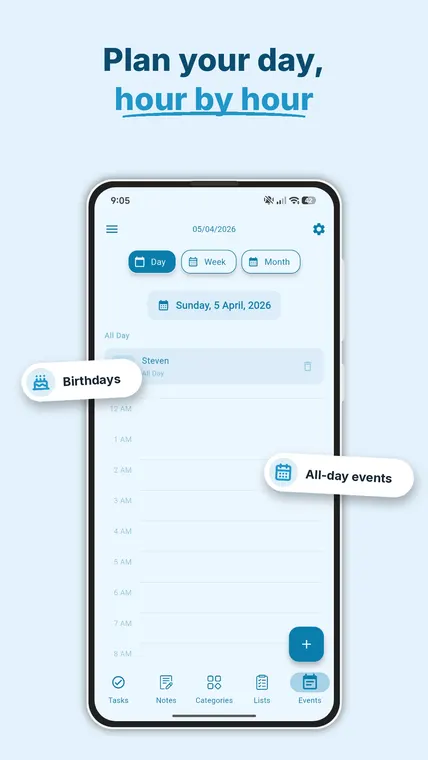
In My Tasks: Lists & Schedules, recreate each line of this template as a recurring task with a reminder — you can paste the plain-text block in to set up quickly. Set your morning stack to repeat daily, your workday shutdown for late afternoon, and your evening wind-down before bed. Group them with categories so each phase is its own checklist, and watch the routine run itself. The core app is free; premium adds cloud backup and real-time sharing if you want to keep a household routine in sync. And if you tried running routines in a paid task manager and hit its limits, My Tasks is an app like Todoist that's completely free.
Daily routine FAQ
Is this daily routine template free to print?
Yes, it's free with no signup. Use the Print button for a clean one-page printout, copy the plain-text version with one tap, or save it as a PDF from the print dialog. There's no email wall.
Which sample routine should I start with?
Start with the one that matches the time you genuinely have in the morning — 30, 60, or 90 minutes. A short routine you actually follow every day beats a long, ambitious one you skip after a week.
What is habit stacking?
Habit stacking attaches a new habit to one you already do, using the formula "After [existing habit], I will [new habit]" — for example, "after I pour my coffee, I will write my top 3 tasks." The existing habit becomes the trigger so you don't have to remember.
How do I get reminded to follow my routine each day?
Paper can't nudge you. In My Tasks you turn each routine step into a recurring task with a reminder, so your phone prompts you at the right time every day — morning, workday shutdown, and evening wind-down — and the routine repeats automatically.